
‘90s TV, Memory, and the Making of Our Sometimes Home
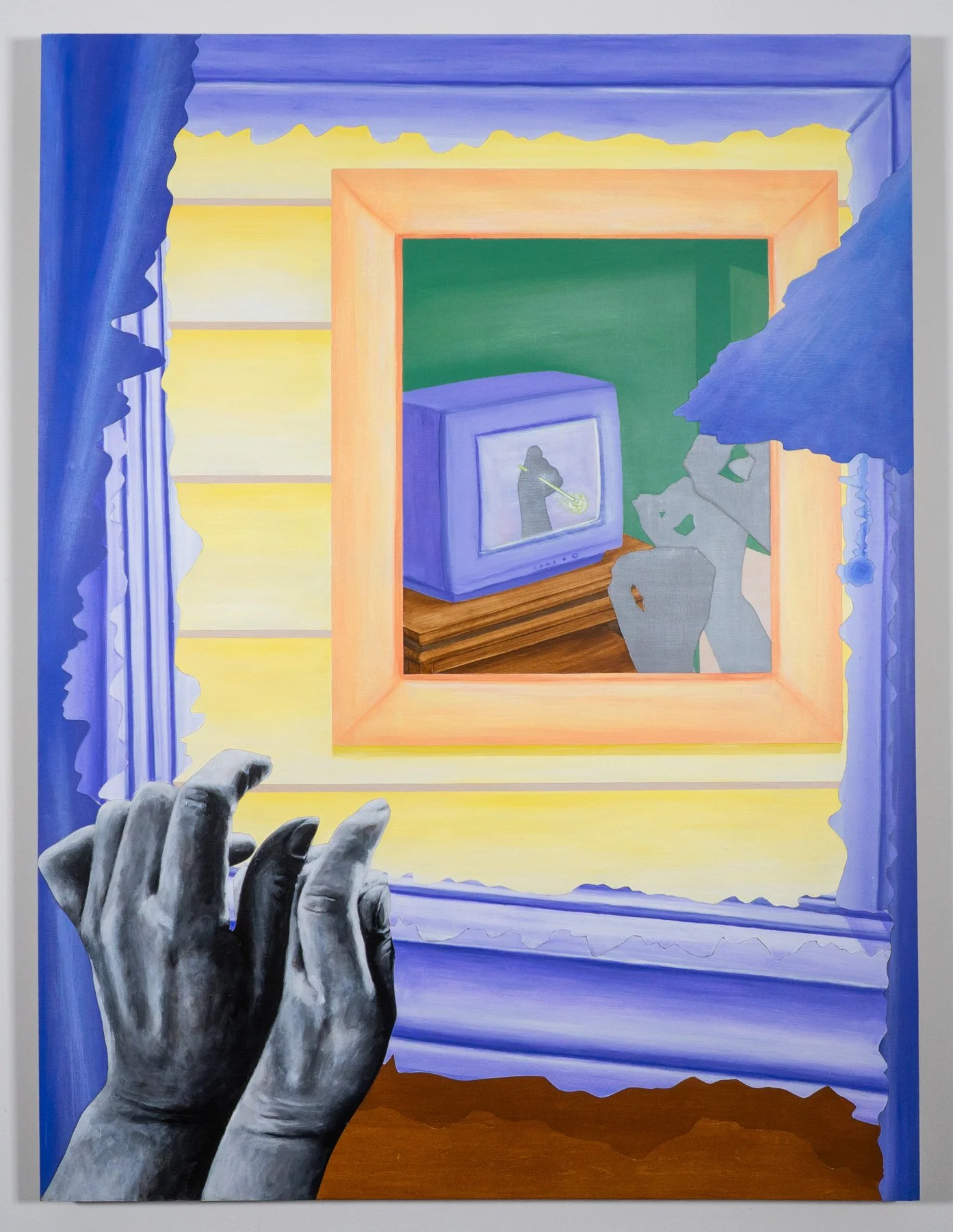
It’s fun! For the whole family, 2026, 40 × 30 in, Acrylic and stain on wood panel
I'm in the thick of working on this show Our Sometimes Home.
Before starting on what this show is now, I thought that I already had a direction I started last fall. But after I got home from my residency, I felt like I had closed the chapter on horror. Mainly, I needed to close the chapter on feeling fear all of the time, my body was physically tired of the fantasy fear and the real fear all around me.
After my last post, although I deeply love Agustina Bazterrica, I closed the book Nineteen Claws and a Blackbird. But to be honest, I watched all episodes of BBC’s new adaption of Lord of the Flies first, then I was done.
As I started over, in conjunction with the first piece, It’s fun! For the whole family, I wrote a poem to ground me which helped identify the underlying thought for this exhibition:
When is childood?
Is it 1 to 13?
Does it end when you’ve seen
Things that are…maybe…not that good?
What if you’re 5?
Is it too early to be
Seen by the world
And to see world-ly?
Do you take care of mom and dad?
Are they anxious, grieving, and overall sad?
It’s ok—the tv is here for you.
Colorful, magical, bright and right.
I’ll take care of you throughout the whole night.
So if you’re 8
And you’ve seen too much
Give me your eyes
And I'll give you a parent’s touch.
Transitioning out of horror, I found myself grasping for counteractive feelings of nostalgia,
which I always find kinda funny because my nostalgic memories were pretty traumatic. It’s interesting how our memories find the good in things, even when in reality the context of those memories may not have been that good.
I have written about this several times, and possibly too much when I was young when I thought that I was going to be a writer, but for context my parents had an arranged marriage. My mother immigrated to the United States, after marrying my dad who was visiting the Philippines, and she became a stay home mother to my half siblings in Montana. Eventually she had two of her own children, and we lived a very conservative life where she had little freedom. Many of my first memories were of domestic abuse and my parents’ divorce.
When I first pitched this show, I wanted to explore how culture shifted between the two homes of divorced interracial parents. What did these homes look like, and how do mixed kids code-switch between each home? What I wanted to focus on was that the culture held in the two homes weren’t so black-and-white after all. My dad inherited a lot of Filipino culture from the decade-long marriage with my mom, and my mom also inherited much of his white Americanisms.
But between the pitch and the progression in my work from exploring my own interracial relationship to exploring race as an abstract concept through metaphysical metaphors, I found myself latching on to some of the nostalgia associated to the recent horror work.
As you know, Sabrina the Teenage Witch, Twitches, and Halloweentown were shows that I was examining for their race-coded narratives. I was analyzing the presentation of code-switching in Disney and other children’s fantasy about teenage mixed-race witches navigating home and public life.
The more that I was rewatching these foundational TV shows and movies for inspiration, the more I was revisiting what it felt like to escape into them.
For my family, the TV was often the only escape from the feelings of grief we were constantly surrounded by. Because my parents’ marriage was formed around survival for one, and power for the other, race and religion were a constant underlying influence that created conflict. As a child to young adult processing my parents’ battle to control our foundational morality, we were constantly living in fear of god in one home, and in the other living with the pervasive loneliness and sadness from grieving a family and culture left behind. The TV was a universal safe space in each home, and even in the homes of others while we watched TV in windows driving to and fro.
My freedom was in the TV. It was a place I went to after school, or visited all day long when I skipped school, which was often. From my friends Sabrina and Marnie, although mixed in a different kind of way, I learned how to keep barriers between my home life and my public life. And because we lived far from our real friends in town, the TV was how I learned and internalized social norms and American culture.
Our Sometimes Home is an exploration of two hand characters internalizing messaging about family and the idealized American life through the TV. Whether viewing their own, or as voyeurs watching TV with families through windows, this show is about the TV as a safe space for these characters, and how that gives its messaging a keen level of influence.
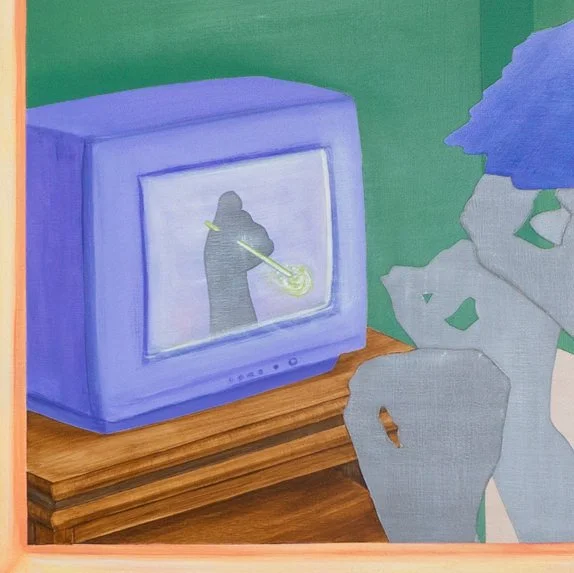
Detail of It’s fun! For the whole family

Studio shot of paintings Is that so? and It’s fun! For the whole family
